Processing layers
How a stored email is read in layers, from naming its stage to suggesting products.
Once an email and its files are stored, the processing side reads it in layers. Its files are converted to text first. The next layer decides what the email is, and only an enquiry goes on to be read in full. How the email reaches this point is on Mail to processing and Worker jobs.
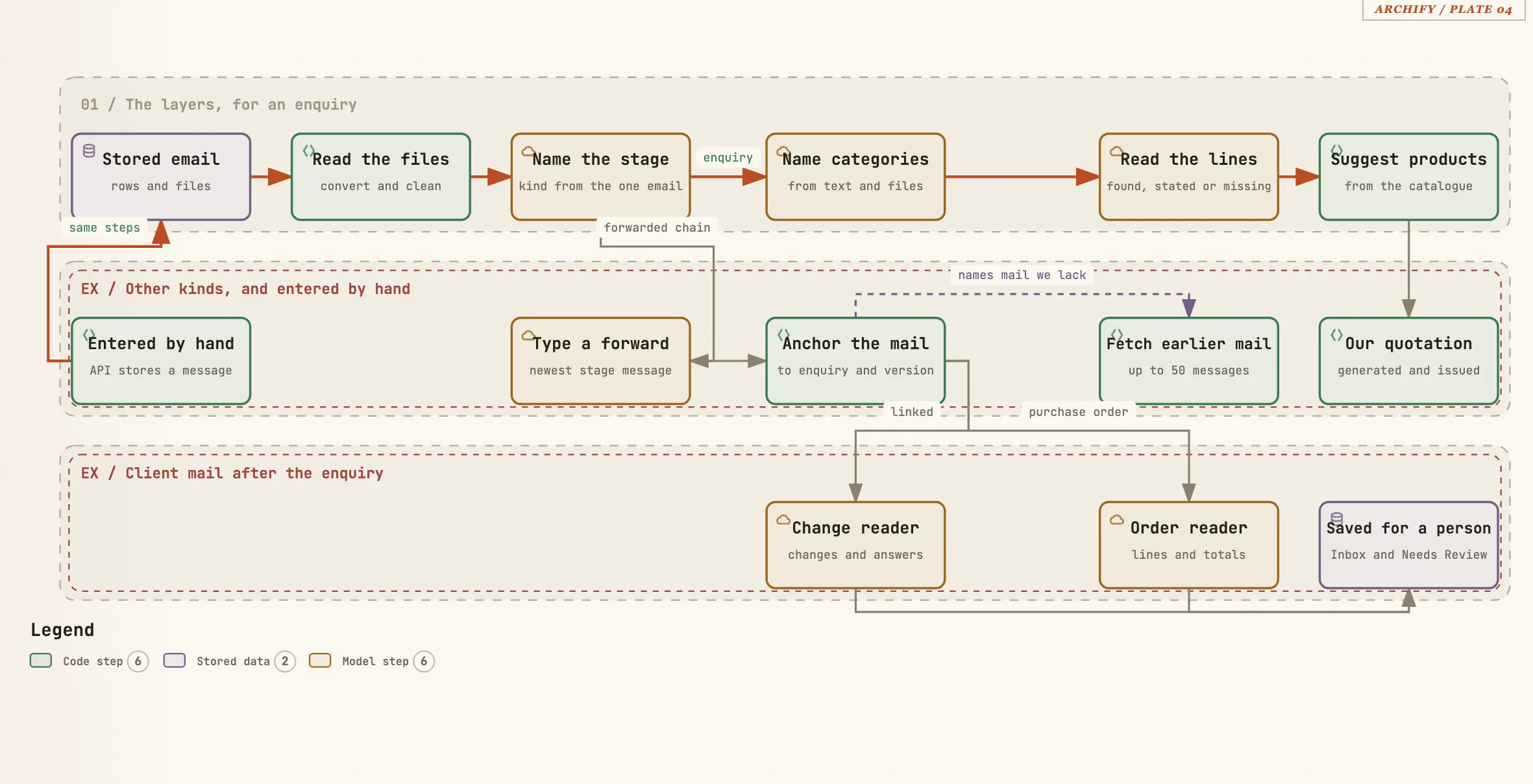
Stages. An email is an enquiry, a quotation, a purchase order or a sales order; a revision request, a follow-up such as a chaser, and anything else are named too. The model names the kind from the one email. A forward of a whole conversation with no note of its own is typed by its newest message that moves the stage, each message judged on its own words, sender and subject; a forward with no such message is typed as one email. Tracking a deal’s stage across the whole conversation, so that a deal only moves forward, is not built.
Post-quote mail is anchored. After an email is typed, it is linked to the enquiry, and the sent quotation version, it answers (R97). An enquiry email that answers a quotation, whether it cites a quote number or replies to the email the quotation was sent on, is read as a revision request and is not read as an enquiry. Mail that matches several quotations, and a revision request or purchase order that matches none, waits in Needs Review with the reason; where fetching earlier mail is on, FlowOS first asks for the earlier mail it names.
When unsure, the email waits in Needs Review for a person to pick its type, unless it links by our quotation number or to a quotation version, or to a quotation made outside FlowOS (R7). When the model call fails, the job is retried, and an email still not classified after that is sent for review.
Reading an enquiry. Once labelled, an enquiry is read for its catalogue categories, what the client asks of the offer and by when, and who the client is, from the client’s own words and signature. Rules read what can be checked, and each model is asked one narrow question. A forward’s colleague note is recorded as routing. A client email that arrives again within 30 days, at the same office, and adds nothing, not even a forwarding colleague’s words, is a copy, and is not read at all. So is a reply of ours, addressed only to us, that says nothing of its own and carries no files, over a client’s email forwarded inside Flowtech, when the client’s words match an email already held from that client under the same subject, whatever files that email had. Enquiry reading has how each part is read, what each model is sent, and the copy rule.
Client mail after the enquiry. Linked client mail is read again by purpose. The change reader reads a revision request, follow-up, later enquiry email, purchase order or other mail for what the client asks to change, answers to our open questions, and lines the client adds, and the purchase order reader reads a purchase order for its lines, terms and totals, each value with its evidence. Both save what they read for a person to settle (Inbox, Checking a purchase order).
Entered by hand. An enquiry a person enters from a call or a chat is read like an email from the reading on. It is never a copy, its customer and owner stay as the person chose them, and it starts gathering even when no category is confirmed. Enquiry reading has the detail.
This is the design the build follows. Naming the stage, and naming an enquiry’s categories, its asks and its contact, are built. So are the layers after them: gathering an enquiry’s requirement lines, which starts by itself once the reading confirms a category and can be run again from Mail Debug (Requirement gathering), and suggesting products for each line (Product suggestion).